
In this guide, we’ll walk through how to recognize potential reading difficulties, what might be causing them, what evaluations can tell you, what effective intervention looks like, and how to know whether your child is making meaningful progress.
Most parents who find this post arrive here because of something small. A comment at a parent-teacher conference that didn’t quite land right. A moment at homework time that felt harder than it should. A nagging feeling that something is off, even if you can’t name it. If something feels off, that instinct is worth following.
In this guide:
- Signs Your Child May Be Struggling With Reading
- Common Causes of Reading Difficulties
- Reading Evaluations, Testing, and Screening
- Reading Intervention and Structured Literacy
- Measuring Reading Progress
- When to Seek Additional Support
Is this real, or am I overreacting?
You’re probably not overreacting. And the cost of finding out you were wrong is zero. The cost of waiting to find out you were right can be significant. The window for early reading intervention is real, and the research on this is unambiguous.
Here’s how to start figuring out if your concern is warranted.
What teachers are actually telling you
Teachers are trained to be encouraging. They lead with the positive, soften the difficult, and rarely volunteer alarm. That means parents have to learn to read between the lines — because by the time a teacher is saying something cautious, they’ve usually been watching it for a while.
Comments that parents often minimize but shouldn’t:
- “She’s working so hard” — when effort is this visible, it often means the work isn’t coming naturally. Hard work is good; effortful struggle at basic tasks is a sign.
- “He’s right where we’d expect him to be” — this usually means compared to his class, not compared to grade-level norms. These are not the same thing.
- “We’re keeping an eye on it” — they see something. This is an invitation to ask what, specifically.
- “She might just need more time” — sometimes true. Often a way of deferring a harder conversation.
- “He’s making progress” — progress toward what benchmark, compared to what starting point, at what rate? This phrase means almost nothing without context.
- “I’d love to see her reading more at home” — this can be a genuine suggestion or a flag that fluency is lagging. Ask which one it is.
- “He’s a bright kid, he just needs to apply himself” — for a child with a reading difficulty, this is one of the most damaging framings. Effort is rarely the problem.
If any of these sound familiar, take them seriously. Then go watch your child read.
What to look for when you sit with your child
There’s a lot you can learn in ten minutes. Ask your child to read something aloud — a book they’ve been assigned, something at their grade level. Sit close enough to see the page. Watch for:
- Tracking with a finger long past the age when most kids have stopped
- Skipping words or whole lines
- Substituting a word that starts with the same letter (“house” for “horse”, “was” for “saw”)
- Guessing from the picture rather than reading the word
- Reading so slowly that meaning gets lost
- Losing their place repeatedly
- Visible frustration, avoidance, or shutting down
If you have a same-age child in your life — a friend’s kid, a cousin, a neighbor — notice the difference. Or search YouTube for “second grade reading aloud” (or whatever grade applies) and watch a few clips. Seeing a peer read at grade level is often the moment a parent’s concern crystallizes from vague to specific.
It’s also worth remembering that reading development isn’t perfectly linear. Letter reversals are common in kindergarten and early first grade. Many young readers sound out unfamiliar words slowly. Some children develop reading skills later than their peers and still catch up without intervention. The question isn’t whether you observe any one concerning behavior. It’s whether the pattern persists over time, appears across multiple situations, or seems out of step with what you’d expect for your child’s age and grade.
How reading is supposed to develop
Reading isn’t a single skill. It’s a sequence of skills that build on each other, and a gap at any level makes everything above it harder.
Here’s the basic architecture:
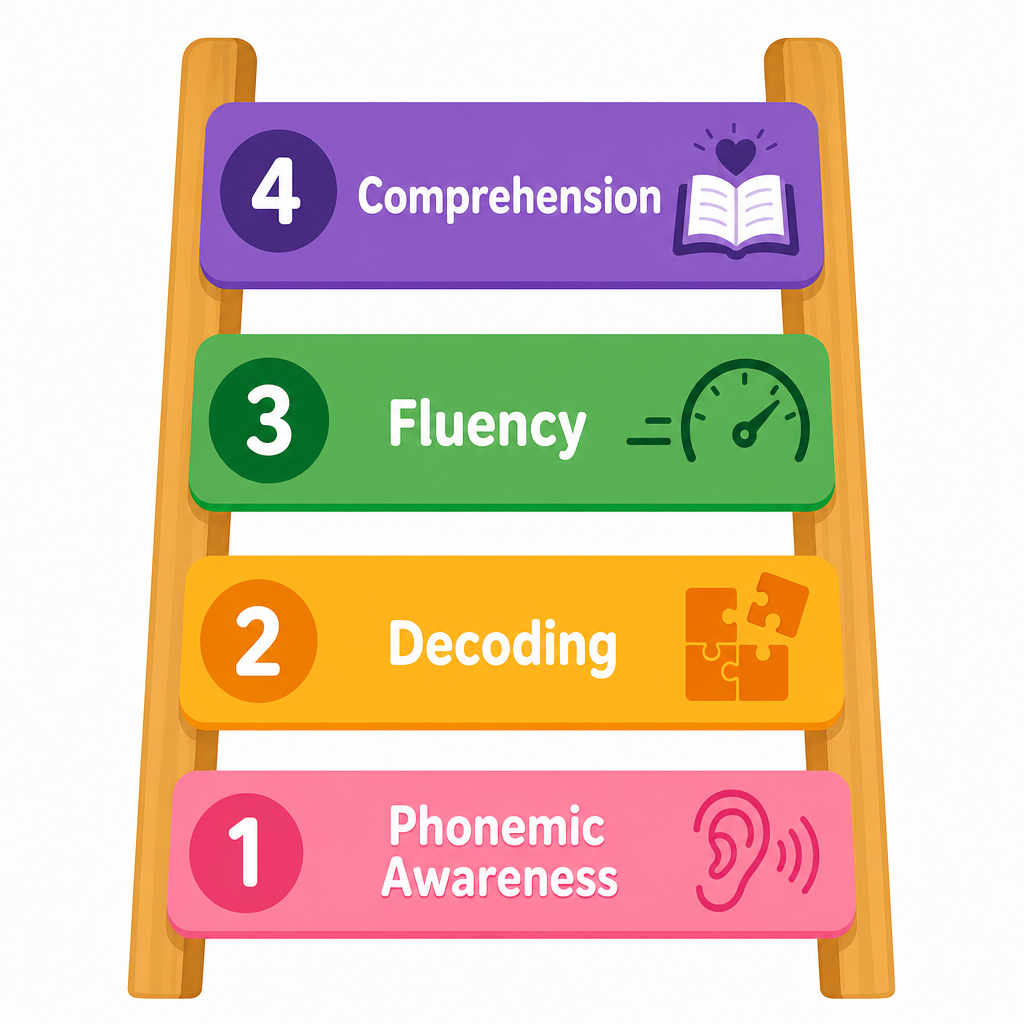
- Comprehension — understanding what the words mean, together, in context.
- Fluency — reading accurately and automatically, without laboring over each word. Fluency frees up mental bandwidth for comprehension.
- Decoding — translating letters into sounds and blending them into words. This is the mechanical engine of reading. “Sounding out” a word is decoding.
- Phonemic awareness — hearing and manipulating the individual sounds in words. This is pre-reading. A child who can’t hear that “cat” has three sounds (/k/ /a/ /t/) will struggle to decode.
The sequence matters. A child who hasn’t solidified decoding will spend so much cognitive effort on individual words that comprehension suffers — even if their verbal comprehension is strong. This is why a child can seem bright, articulate, and curious while still struggling to read. The problem isn’t understanding. It’s the mechanical process of getting the words off the page.
Reading development spirals: children learn letter sounds, then blend them into short words, then recognize those words automatically so reading speeds up, then encounter more complex word patterns — and the cycle repeats at increasing levels of complexity. A gap in the early stages doesn’t fix itself as the material gets harder. It compounds.
Where your child should be — and how to check
Every state publishes academic standards that describe what students should be able to do at each grade level. These are publicly available, specific, and most parents have never read them. They’re worth looking up for your child’s current grade.
As a rough guideline:
- Kindergarten: Recognize and produce rhymes, identify letters and their sounds, blend and segment simple words into individual sounds, and begin reading simple consonant-vowel-consonant words.
- End of 1st grade: Read simple books with increasing accuracy, decode most one-syllable words (including common vowel patterns), recognize high-frequency words automatically, and begin reading connected text with some fluency.
- End of 2nd grade: Read grade-level text accurately and with improving fluency and expression, decode most one- and two-syllable words, retell stories with key details, and answer questions about what they’ve read.
- End of 3rd grade: Read grade-level text fluently and independently, handle many multi-syllable words, use reading to learn new information, and demonstrate comprehension of chapter books and increasingly complex informational texts.
Third grade is the inflection point that researchers and educators consistently flag. It’s not that children are done learning to read by third grade. It’s that the curriculum stops teaching foundational reading mechanics and starts assuming them. Instruction shifts toward comprehension, vocabulary, and content knowledge. Reading becomes the vehicle for learning everything else.
A child who hasn’t solidified foundational skills by this point doesn’t stop needing them, they just stop being taught them. And because reading is now the assumed means of accessing every subject, a gap that was visible mainly during reading time in first and second grade becomes a gap that shows up everywhere: math word problems, science texts, social studies, history. The reading difficulty doesn’t necessarily get worse, but its consequences spread.
This is why older children with unidentified reading difficulties often look like they’re struggling across the board. The root is still reading, but by fourth or fifth grade it’s harder to see that clearly.
A self-service next step
If you’ve read this far and your concern has sharpened rather than eased, a dyslexia symptom inventory is a useful next step. These aren’t diagnostic tools (they can’t tell you whether your child has dyslexia) but they translate clinical symptoms into observable behaviors and give you a concrete list to bring to a teacher or pediatrician.
Two reliable ones:
Fill one out. Then move to the next section.
What could actually be causing this?
If something is getting in the way of your child’s reading, the cause matters — because different causes require different responses. A child who struggles because of an attention issue needs something different than a child who struggles because of how their brain processes language. And what looks like the same problem on the surface — slow reading, avoiding books, falling behind in class — can have very different roots.
Some children have a learning disability. Others have instructional gaps, attention challenges, language weaknesses, or a combination of factors. The goal at this stage isn’t to diagnose anything — it’s to understand the possibilities.
Dyslexia and other language-based reading disabilities
Dyslexia affects the ability to decode words accurately and fluently and is rooted in how the brain processes language at the sound level. Most children with dyslexia have difficulty with phonological processing — hearing and manipulating the individual sounds in words — but dyslexia can also affect rapid automatic naming, the ability to quickly retrieve the names of letters, numbers, colors, and objects. A child can be highly intelligent and have significant dyslexia.
Looking back, many parents recognize earlier clues that seemed unrelated at the time: difficulty learning nursery rhymes, delayed speech, trouble remembering sequences such as days of the week, persistent pronunciation errors, or frequent word-finding difficulties.
Family history is another important clue. Dyslexia and other reading difficulties often run in families. If a parent, sibling, aunt, uncle, or grandparent struggled significantly with reading, spelling, or writing, that’s information worth sharing with your child’s school or evaluator.
Instruction gaps
A child who didn’t receive systematic, explicit phonics instruction in the early grades may look like they have a reading disability when they actually have an instruction gap. This is more common than many parents realize.
Many schools spent years using reading approaches that did not provide enough direct instruction in how sounds map to letters and words. This history is one reason the Science of Reading movement has gained so much attention in recent years and is the subject of the investigative podcast Sold a Story, which is worth a listen if you’d like to understand how reading instruction evolved and why some children were left behind.
Some children learn to read successfully under a wide range of instructional approaches. Others need explicit, systematic phonics instruction to crack the code. That’s not a disability—it’s a learning profile. If your child was in school during a period when foundational reading instruction was weak or inconsistent, an instruction gap is worth considering before assuming a disability is the sole explanation.
Of course, instruction gaps and disabilities aren’t mutually exclusive. A child with dyslexia may struggle because they have a language-based reading disability. Another child may struggle because they never received the instruction they needed. A third child may have both. Part of the challenge—and the reason evaluation matters—is figuring out which explanation best fits your child.
ADHD and executive functioning challenges
ADHD affects attention, working memory, and self-regulation — all of which reading demands heavily. A child with ADHD may decode accurately but struggle to stay focused long enough to understand what they read. They may skip lines, lose their place, rush through text, or have difficulty remembering what they just read.
This can look like a reading problem when the primary challenge is attention. Of course, some children have both ADHD and dyslexia, and the combination is common.
Language weaknesses
Some children can read words accurately but still struggle to understand what they read. In these cases, the difficulty may be related to language development rather than decoding.
A child with language weaknesses may have trouble understanding vocabulary, following complex sentences, making inferences, or connecting ideas across a passage. These challenges are more common in children with a history of language delays, but they can appear in many different ways.
Other factors that can contribute to reading difficulties
Vision and tracking issues involve how the eyes move across a page, coordinate with one another, and maintain focus while reading. These difficulties can contribute to losing place, skipping lines, or visual fatigue. They are generally considered distinct from dyslexia and other language-based reading disabilities, though a child can have both.
Auditory processing difficulties affect how the brain interprets sounds, even when hearing is normal. A child may hear adequately in conversation but struggle to distinguish similar speech sounds, which can make learning letter-sound relationships more difficult.
These causes frequently overlap. A child may have dyslexia and ADHD. A mild reading disability may be compounded by weak instruction. A vision issue can make an existing reading difficulty harder to manage. Understanding what is actually happening is important because the right intervention depends on the right explanation.
What information do you actually need — and how do you get it?
Once you suspect something is going on, the natural instinct is to act. But acting well depends on understanding what you’re dealing with — and that means getting the right kind of information. There are several distinct ways to assess a child’s reading difficulties, and they answer different questions. Knowing which one you need, and what each one can and can’t tell you, saves a lot of time and frustration.
Screening: the first flag
Most states now require schools to screen students for dyslexia risk, typically in early elementary grades. If your child has been screened and the result flagged a concern, that’s a signal worth taking seriously. Screening is a quick pass designed to identify children who may be at risk. It doesn’t tell you what’s causing the difficulty, how significant it is, or what to do about it.
Screening results are also often blunt instruments — typically a binary “at risk” or “not at risk” designation in the parent report. What most parents don’t know is that the screening tool usually captures more granular data than what gets shared. If your child is flagged, it’s worth asking the school what the full results show, not just the summary designation.
A screening flag may prompt the school to provide additional reading support — extra small group instruction, intervention time, a different reading group. That support can be meaningful, but it operates within general education and is different from a formal evaluation for disability services, which in most cases requires a separate parent request. The screening result is information — what you do with it is largely up to you.
One pathway parents often overlook is assessment through a structured literacy tutor. A good tutor will do their own skills assessment before starting work with your child — not a clinical diagnosis, but a targeted picture of where the gaps are: which phonics patterns are solid, which aren’t, where fluency breaks down. This kind of assessment is focused on what needs remediation rather than why, but it’s practical, relatively fast, and useful to have while you’re waiting for anything more formal.
School evaluation: eligibility, not diagnosis
To access specialized reading instruction through your school at no cost, your child first needs to qualify for special education services. This surprises many parents who associate special education with more visible disabilities. But it’s simply the legal framework that funds individualized instruction for any child whose disability affects their education. Qualifying isn’t a statement about your child’s severity. It’s just how the system works.
Under that same federal law, schools are required to identify and evaluate children who may need special education services — a provision known as Child Find. This means you don’t have to wait for a teacher to refer your child; you can request an evaluation in writing at any time.
A school evaluation typically includes assessment of academic achievement in reading, writing, and math, as well as cognitive and processing measures relevant to the area of suspected disability. For a reading concern, that should mean phonological awareness, decoding, fluency, comprehension, and potentially processing speed and working memory. What you actually get varies substantially by district — some evaluations give you a genuinely useful picture of your child’s learning profile; others do the minimum required to make an eligibility determination. This matters because the evaluation results directly drive what help the school offers. An evaluation that’s too narrow to capture the full picture will produce goals and services that are too narrow to address it. You have the right to ask what assessments were administered and whether all areas of suspected need were covered — and if you believe the evaluation was incomplete, you have the right to request an Independent Educational Evaluation (IEE) at the school’s expense under certain conditions.
What a school evaluation is designed to determine is eligibility (i.e. whether your child meets the criteria for an IEP or 504 plan), not to provide a clinical diagnosis. This is the source of one of the most confusing things parents encounter: a school telling them they “don’t diagnose dyslexia.” This isn’t always an evasion — it reflects a genuine difference between educational eligibility and clinical diagnosis. A child can have dyslexia and not qualify for an IEP under the school’s criteria. A child can qualify for an IEP without ever receiving a dyslexia diagnosis. We go deeper on this distinction in ‘Can Schools Diagnose Dyslexia? Understanding School vs. Private Testing’.
Private psychoeducational evaluation: the full picture
A private evaluation conducted by a neuropsychologist or educational psychologist outside the school system is the most comprehensive assessment available. Where a school evaluation asks “does this child qualify,” a private eval asks “what is actually going on, and why.”
A full psychoeducational evaluation typically looks at cognitive abilities, phonological awareness, rapid naming, working memory, processing speed, and academic achievement
It can provide a clinical diagnosis — dyslexia, ADHD, auditory processing disorder — and crucially, it tells you not just that there’s a problem but what kind and why. That’s what drives the right intervention. But they run $2,000 – $5,000 and are not always covered by insurance.
One thing parents often discover the hard way: arriving at school with a private neuropsych report in hand does not automatically substitute for the school’s own evaluation process. Most schools will want to conduct their own assessment regardless of what a private evaluation found. This isn’t obstruction. Schools have their own legal obligations and eligibility criteria that are separate from clinical diagnosis. What a strong private eval can do is inform the school’s process, provide a richer picture for the IEP team, and sometimes compress the timeline. But the school’s eligibility determination remains a separate step with its own process.
The through-line
Think of these three pathways as answering different questions:
- Screening tells you whether to look further
- A school evaluation tells you what the school needs to address
- A private evaluation tells you why your child is struggling
What should your child actually be getting?
The evaluation process tells you what’s going on. This section is about what to do with that information.
Structured literacy instruction is the intervention that works
If your child has dyslexia (or something that looks like it), the research is clear on what works: structured literacy instruction. This is explicit, systematic, sequential teaching of how letters map to sounds, how sounds combine into words, and how words build into fluent reading. It goes by different names in practice: Orton-Gillingham, Wilson Reading System, Speech-to-Print, and others. They’re not identical, but they share a common architecture: teach the code directly, in sequence, with repetition and mastery before moving on.
Structured literacy instruction can be delivered at school by a trained reading specialist or special education teacher, or privately by a tutor who is trained and certified in one of these programs. The setting matters less than whether the instruction itself is structured literacy.
What won’t move the needle for a child with a decoding difficulty: general reading support focused on comprehension strategies, vocabulary, and reading exposure. These have value, but they don’t address the underlying phonological gap. A child can be getting “reading help” in a meaningful sense — attentive, well-intentioned, consistently delivered — and still not be getting what they need.
The question to ask in any setting: what program or approach are you using, and what is your training in it?
If your child has co-occurring challenges — ADHD, language processing difficulties, executive functioning gaps — those may need to be addressed alongside reading remediation, not instead of it. And if your child’s primary difficulty is comprehension rather than decoding, the intervention picture looks different. Structured literacy is the right answer for a phonological gap, but a child who decodes accurately and still doesn’t understand what they’ve read needs something else.
‘A Parent’s Guide to Dyslexia Programs and Tutoring’ covers the program landscape in detail — what distinguishes the major approaches, how to evaluate providers, and what to look for in both school and private options.
Accommodations and remediation are different tools for different jobs
Your child may need both. But they’re not substitutes for each other, and conflating them is one of the most common ways IEPs undershoot.
Accommodations reduce the impact of a reading difficulty on performance: extended time, audiobooks, text-to-speech, reduced written output, oral testing. These are appropriate and often necessary. They allow a child to access curriculum and demonstrate knowledge without the disability getting in the way.
Remediation teaches the underlying skill. It’s the direct instruction that works toward closing the gap.
Extended time helps a child cope. It doesn’t teach them to read faster. Audiobooks allow a child to access a novel. They don’t build decoding. Both have their place — but a child who is only accommodated, without any remediation, is a child whose reading difficulty is being managed rather than addressed.
A well-designed plan includes both. The accommodations support access now; the direct instruction is improving reading skills.
The right program isn’t enough (aka implementation is everything)
Parents sometimes secure the right program and still don’t see meaningful progress. Often the problem is implementation.
Frequency and dosage. Research on structured literacy intervention generally points to a minimum of four to five sessions per week for students with significant reading difficulties, with sessions long enough to build genuine fluency — typically 45 to 60 minutes. A child receiving one 30-minute pull-out session per week is unlikely to close a meaningful gap, regardless of what the program is.
Teacher training and certification. Structured literacy programs require specific training to deliver correctly. There’s a meaningful difference between a teacher who attended a one-day workshop and a certified dyslexia therapist or a Wilson-certified interventionist. It’s reasonable to ask: what is your training in this program, and how long have you been delivering it? And it’s worth knowing who specifically will be working with your child — a certified specialist or a paraprofessional supervised by one.
Fidelity to the program model. Structured literacy programs are designed as systems. A provider who pulls pieces from multiple programs, skips components, or adapts freely may undermine what makes the approach work. Some flexibility is normal; significant deviation from the model is a flag.
Progress monitoring built into the intervention. Good structured literacy instruction includes regular, data-based checks on whether a student is actually acquiring the skills being taught, not just a general sense that things are going better. This is what tells you whether the intervention is working, and what should be driving decisions about next steps.
However, knowing whether progress is actually happening turns out to be harder than most parents expect.
How do you know if it’s working?
This is the question most parents find hardest to answer because the information is genuinely hard to pull together and understand.
The goal isn’t progress. It’s closing the gap.
This distinction matters more than almost anything else in this section.
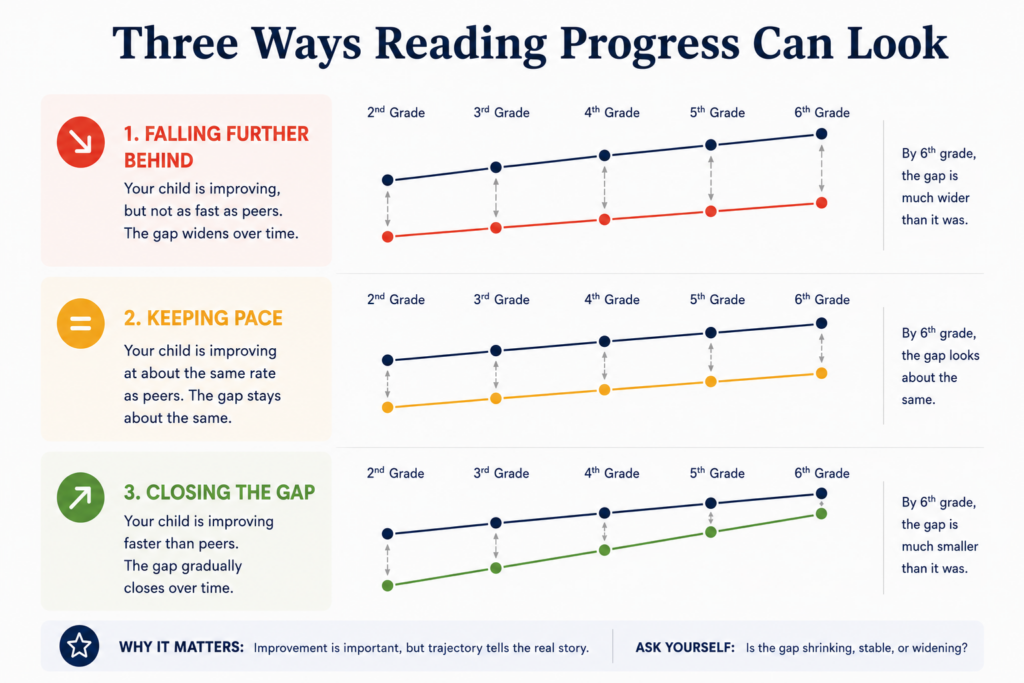
A child receiving intervention will often make real gains. Their decoding improves. Their fluency increases. Their teacher reports that they’re doing better. All of that can be true — and the child can still be falling further behind grade-level peers, because typical readers are also progressing, and the gap widens when intervention-driven growth doesn’t outpace normal development.
Oral reading fluency (ORF) — words read correctly per minute — is one of the clearest ways to see this. Hasbrouck and Tindal’s widely used ORF norms give benchmark ranges by grade and time of year: a typical mid-year second grader reads around 90 words per minute; a typical mid-year third grader around 107; by fifth grade, around 124. A child who moves from 40 to 55 words per minute over a school year has made real progress. But if they’re in third grade, they’ve also moved from significantly below benchmark to still significantly below benchmark — and the distance to grade level may not have closed at all.
That doesn’t mean the intervention isn’t working. In fact, it may represent an important improvement. Some struggling readers make less than a year’s growth in a year and steadily fall further behind their peers. Moving to a rate of growth that keeps pace with typical development can be a significant step forward.
Another way to think about this is through percentile scores on normed assessments (such as those used in neuropsychological evaluations and school testing). Percentiles compare a child’s performance to same-age peers. If a child remains at roughly the same percentile over time, they’re generally making about the same amount of progress as their peers. They’re growing, but they’re not closing the gap. If their percentile is increasing, they’re gaining ground. If it’s decreasing, they’re falling further behind.The question is what happens next. Is the child still falling further behind? Are they now maintaining their position relative to grade level? Or are they making enough progress to gradually close the gap?
For many families, reaching grade-level performance remains the goal. But children differ in the severity of their difficulties, their age, their response to intervention, and the tradeoffs involved. What’s important is that parents understand the trajectory and make informed decisions about it. Is the gap shrinking, stable, or widening? Is the current rate of growth consistent with your goals for your child? Those are the questions worth asking.
What meaningful progress monitoring looks like — and what to do when you don’t have it
Good intervention includes regular, skill-specific data collection — not quarterly report cards or annual evaluation cycles, but frequent probes: ORF measures, phonics screeners, decoding assessments administered every few weeks to track whether the specific skills being taught are actually being acquired. This data should be driving instructional decisions, not just documenting them.
What parents typically receive instead is a progress report that says something like “making steady progress” or “working hard toward goals”, which tells you almost nothing about whether the gap is closing. If that’s what you’re getting, the right question is: can you show me the data behind this? What is being measured, how often, and what do the numbers show over time?
A provider who can’t answer that question concretely is a provider who isn’t monitoring progress in any meaningful sense.
What “not working” looks like
Progress monitoring data that’s flat over multiple reporting periods is a signal. So is a child who is gaining fluency in isolation but not transferring skills to connected text. So is an IEP that gets written to the same goals year after year with the same modest targets.
The clearest sign that something needs to change: the gap to grade level is not narrowing. If a child has been receiving intervention for a full school year and the distance between their performance and grade-level benchmarks is the same or wider, the IEP team needs to revisit the intensity, the frequency, the approach, or all three.
You are allowed to bring this to the table directly. “Our goal is for my child to reach grade level. Based on the current rate of growth, when will that happen?” is a legitimate question, and the team should be able to answer it.
The records problem
Progress data, evaluation results, and grade-level benchmarks arrive as separate documents at separate points in time. A psychoeducational report from two years ago. A progress report from last quarter. ORF scores from the intervention provider, if they’ve been shared at all. None of it comes with context that connects the pieces into a picture of trajectory — which is what you actually need to answer whether the gap is closing.
Tools that organize records and surface progress data as a timeline rather than a pile of documents can make a real difference here. KidvoKit was built specifically for this.
When do you need someone in your corner?
Most parents navigating reading difficulties don’t need a formal dispute process. But there are two kinds of help worth knowing about.
When to hire an advocate
A special education advocate is someone you hire to advocate with you for your child. A good advocate brings expertise in IEP procedures, special education rights under IDEA, and how to negotiate effectively with school teams. The work can include situation analysis, strategy, procedural navigation, drafting letters, and attending meetings — whatever it takes to work toward your goals.
Advocates can bring a lot of insights, but there’s no licensing standard for advocates and quality varies. Ask about their experience, their approach, and whether they’ve worked with your district. COPAA maintains a directory and is a reasonable place to start. If your child’s primary difficulty is dyslexia or a related reading difference, look for someone with specific experience in that area, not all advocates do.
You don’t have to be in crisis to hire one. If you feel consistently outmatched in IEP meetings, if services have been denied or aren’t being delivered, or if you’ve been told your child doesn’t qualify and you don’t believe it — an advocate is worth considering.
This guide was written by Karen Gage, founder of KidvoKit and a parent advocate focused on reading difficulties, dyslexia, and special education. Karen created KidvoKit after navigating her own child’s reading challenges and now helps parents understand evaluations, interventions, and special education services.